
Living longer and living well are not the same project, even though most retirement planning treats them as one. You can add years to a life without adding independence to those years: the ability to climb stairs without thinking about it, carry your own groceries, get up off the floor after playing with a grandchild, or travel somewhere new without a chaperone. That kind of independence does not arrive automatically with good genes or a clean bill of health. It is built, maintained, and occasionally rebuilt, through specific choices made consistently over time.
This matters because the medical system is mostly built to treat disease, not to protect function. Your annual checkup can tell you that your blood pressure and cholesterol are fine while saying nothing about whether you can still get up from a low chair without using your hands. That gap, between being disease free and being functionally independent, is where most of the real work of aging well actually happens. Closing it takes a framework, not a to-do list.
Why Living Longer Isn’t the Same as Living Well
Lifespan measures years. Independence measures what you can do inside those years without asking for help. A person can live into their nineties while losing the ability to walk unassisted at seventy five, and that loss of function, not the eventual date on a headstone, is what actually shrinks a life. It narrows where you can go, what you can carry, how long you can stand in a kitchen, and whether a vacation involves hiking a trail or watching from a bench.
The research on healthy aging backs this up: grip strength, walking speed, and the ability to rise from a chair without using your arms are better predictors of remaining independent than almost any lab value on a standard blood panel. These are trainable qualities. They respond to what you do this month, not just what your parents passed down. That is the useful part of this whole picture: independence in your seventies and eighties is being built right now, by habits that are still well within your control.
The Four Pillars That Actually Determine Your Independence
Most advice about aging well gets scattered across hundreds of tips: eat more protein, stretch your hips, do a crossword, sleep eight hours. All of that is true and none of it tells you where to spend your limited time and energy first. A simpler way to think about it is four pillars, each covering a different system that has to keep working for you to stay independent:
- Strength and mobility: can your muscles and joints do what you ask of them?
- Metabolic health: does your body manage energy, blood sugar, and weight reliably day to day?
- Cognitive and social engagement: is your mind staying sharp and are you staying connected to other people?
- Recovery: can you bounce back from effort and avoid the injuries that take months to heal?
Neglect any one of these pillars for long enough and it will eventually drag the others down with it. A knee injury that never properly heals (recovery) limits how much you can lift (strength), which makes it harder to maintain a healthy weight (metabolic health), which can affect mood and motivation to stay socially active (cognitive and social engagement). The pillars are not separate projects. They support each other, which is exactly why a framework beats a random list of tips: it tells you which wall to shore up before the whole structure leans.
Pillar One: Strength and Mobility as Your Foundation
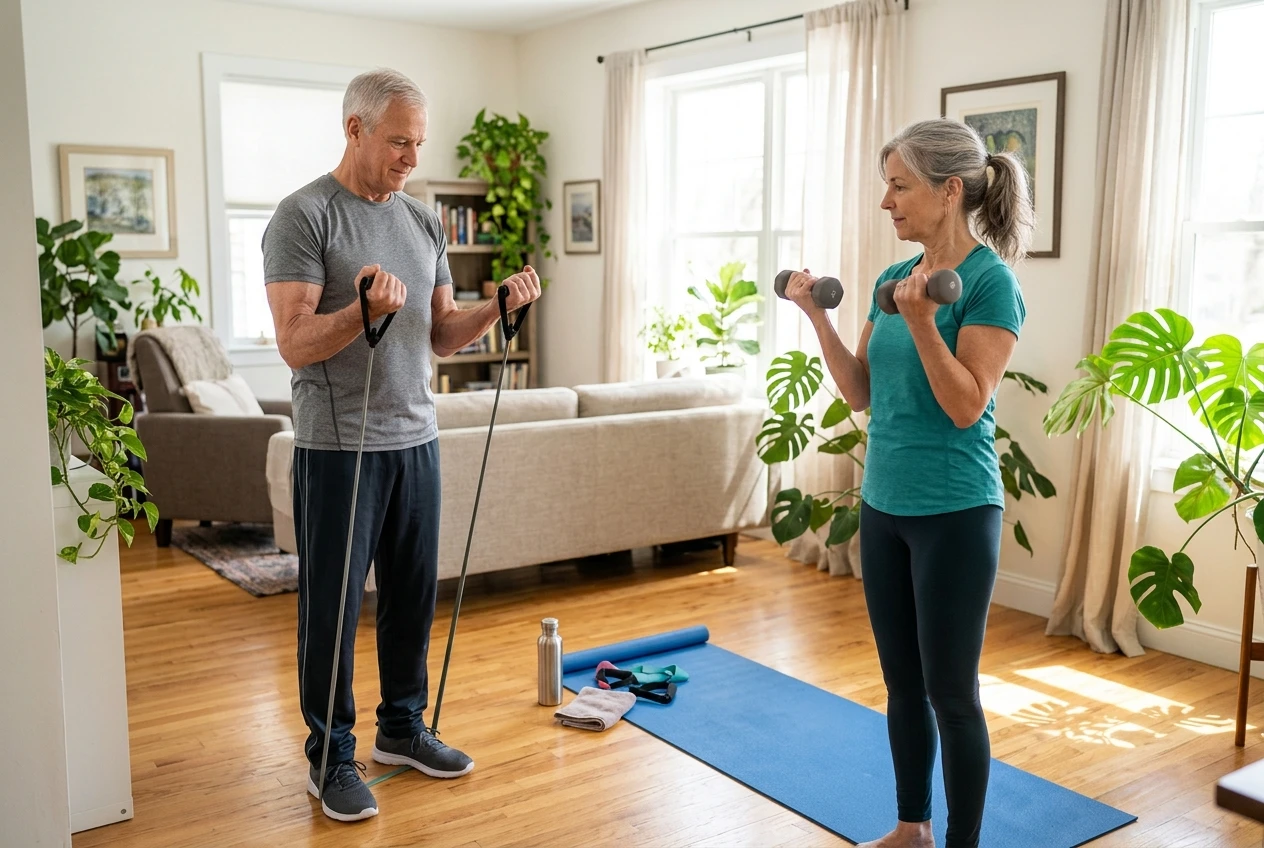
Of the four pillars, this one is the most foundational, because losing strength and mobility is what directly takes away the physical tasks of daily independence: carrying your own bags, getting off the floor, climbing a ladder to change a lightbulb. Muscle mass declines by roughly one to two percent per year after age fifty if nothing is done to counter it, and that decline accelerates further still without intervention. The good news is that muscle responds to training at any age. Resistance work, even light resistance work done consistently, slows and in many cases reverses that decline.
Mobility is the companion piece: the range of motion in your shoulders, hips, and spine that lets strength actually translate into movement. You can have strong legs and still struggle to get into a car if your hips have stiffened up. Coordination, balance, and the way different muscle groups work together also belong here, since a strong body that cannot coordinate movement well is still at risk of falls.
This pillar deserves to be the starting point for most people in their second act, simply because weakness and falls are the fastest routes to lost independence. For a deeper, step-by-step look at building strength safely in this stage of life, Strength Training After 60: A Practical Place To Begin covers how to start without needing a gym membership or prior experience. For the coordination and balance side specifically, Developing Coordination Through Movement covers the training that keeps you upright and steady as the years add up.
Pillar Two: Metabolic Health You Can Count On Day to Day

Metabolic health is the pillar that works quietly in the background until it does not. It covers how your body manages blood sugar, stores and uses fat, and regulates energy levels across the day. When it is working well, you do not think about it: your energy is steady, your weight is manageable, and your appetite behaves predictably. When it is not working well, the first signs are often subtle, an afternoon energy crash, slowly creeping weight gain around the middle, a harder time recovering from the same workout you used to handle easily.
Unlike strength, which you can feel improving in the gym, metabolic health is shaped mostly in the kitchen and at the grocery store, through decisions made dozens of times a week rather than two or three times a week. That makes it less dramatic to work on and easier to let slide. But it is just as load-bearing for independence: metabolic conditions are a major driver of the chronic disease that eventually limits mobility and energy in later life.
The practical side of this pillar comes down to what actually ends up on your plate and in your pantry. Grocery Shopping Tips For Nutritious Meals and How To Manage Weight With Age both go into the specifics of building this pillar in a way that fits into an ordinary week rather than requiring a complete lifestyle overhaul.
Pillar Three: Cognitive and Social Engagement, the Pillar Most People Ignore
Strength training gets attention because its benefits are visible in a mirror. Cognitive and social engagement gets neglected because its benefits are invisible until they are missing. This pillar covers two closely related things: keeping your mind active through learning and problem solving, and keeping yourself connected to other people through relationships and shared activity.
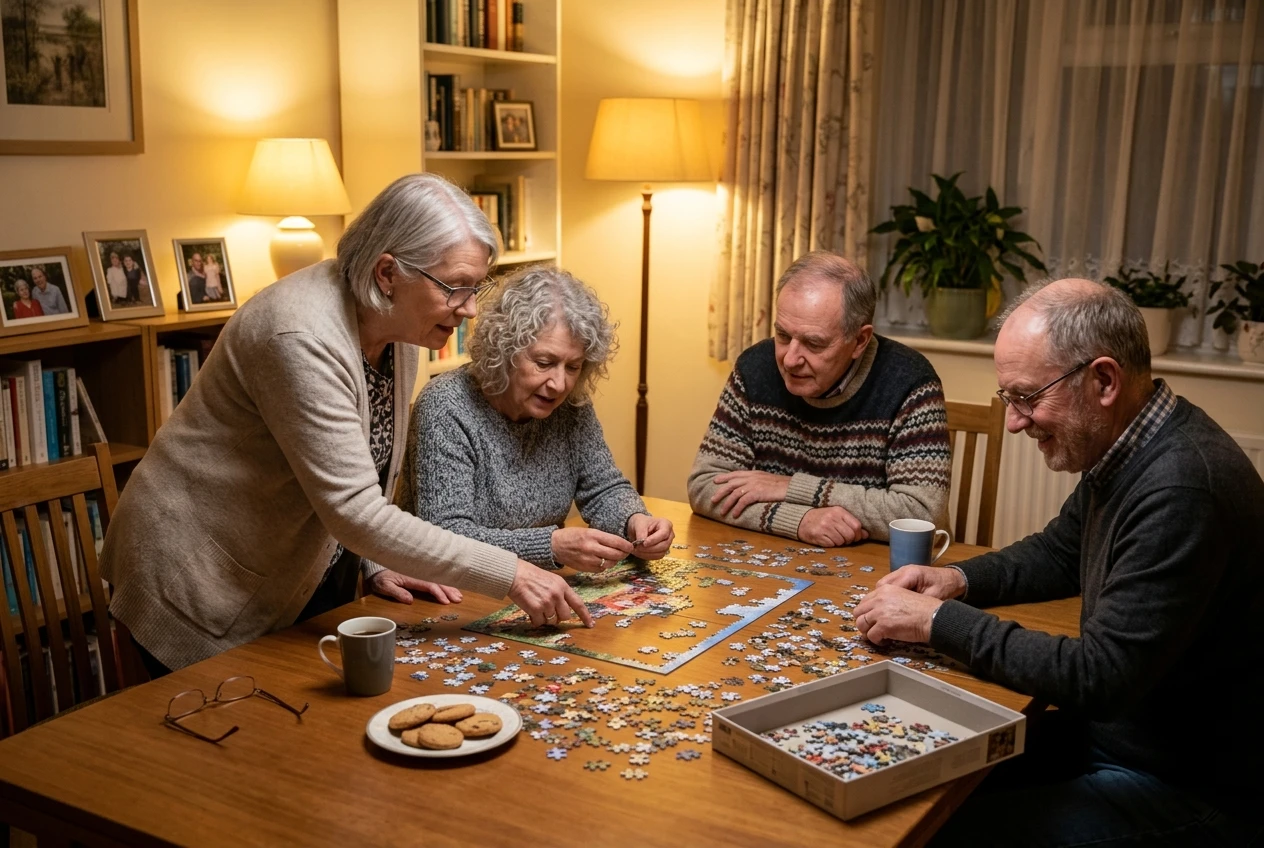
Both matter more than most people assume. Isolation is associated with a decline in health outcomes comparable to smoking, and cognitive decline accelerates faster in people who stop learning new things and stop engaging socially. The two reinforce each other too: a class, a hobby group, or a shared project gives you both mental stimulation and social contact at the same time, which is part of why it tends to be a more effective investment than either one pursued alone.
This is also the pillar that is easiest to let slide once you are no longer required to show up somewhere for work each day. Without a workplace supplying built-in social contact and mental challenge, both have to be deliberately replaced. Online education has become one of the more accessible ways to do that from home, on your own schedule. Benefits Of Online Education For Seniors: Lifelong Learning Opportunities covers why this particular form of engagement has become so practical for this stage of life, and what it can look like in practice.
Pillar Four: Recovery and Injury Prevention Between Hard Efforts
Recovery is the pillar most people skip entirely, because it does not look like doing anything. It is sleep, rest days, proper warm-ups, and the patience to let soreness resolve before pushing again. But recovery is what determines whether the other three pillars keep compounding or keep resetting to zero.

An injury that takes three months to heal does not just cost three months. It costs the strength lost during those months of inactivity, the metabolic changes that come with reduced movement, and often some of the social and cognitive engagement that was tied to the activity you had to stop. This is especially true after fifty, when recovery from an injury takes measurably longer than it did at thirty, and when a bad fall or a torn muscle can cascade into months of reduced mobility rather than weeks.
Good recovery practice is less about avoiding effort and more about respecting the gap between effort and the next effort. That means adequate sleep, genuine rest days rather than days where you simply do a different hard thing, and paying attention to pain that lingers rather than pushing through it. Walking is one of the most underrated recovery tools available, since it keeps blood flowing and joints mobile without adding the stress of harder training. Mindful Walking Practices covers how to use walking this way, as active recovery rather than just low-intensity cardio.
Turning the Four Pillars Into a 90-Day Blueprint
A framework only earns its keep once it changes what you actually do this week. Trying to overhaul all four pillars simultaneously tends to produce none of the follow-through needed to make any of them stick, so the more realistic approach is sequencing.
A reasonable 90-day structure looks like this: spend the first 30 days establishing a consistent strength and mobility routine, since this pillar most directly affects your physical ability to do everything else. Use the next 30 days to tighten up metabolic health, building on the energy and confidence the first month created. Use the final 30 days to deliberately add cognitive and social engagement, now that a physical routine is established and sustainable. Recovery is not a fourth month, it runs underneath the other three from day one, since sleep and rest days need to be in place before you add load, not after you get injured without them.
This sequencing is a starting point, not a rule. Some readers will have more urgent needs in metabolic health or recovery and should start there instead. The point of the framework is to give you a way to decide, rather than leaving you to guess at what matters most.
Pick one pillar to start with this week. If strength and mobility feels like the right place to begin, continue with Strength Training After 60: A Practical Place To Begin.